Brianna Talks Bridge Pose
Being diagnosed with cancer is a funny thing. You are welcomed into a unique club with an absolutely brutal initiation ceremony, including but not limited to invasive surgeries, targeted radiation, or poison injected directly into your veins. But alongside the cold, impersonal, isolating side of illness there is a community unlike any I’ve ever seen. There is an eagerness to listen, to be heard, and to support one another.
When I was first diagnosed with cancer I was living in LA, starting a career as a writer for television. I had begun to wonder what purpose writing truly had – why I was doing it or why anyone should care. When I got cancer, it shifted everything into focus. Storytelling became an important tool for self-preservation, self-discovery, and finding others with similar experiences. I found telling my story helped me maintain a safe distance from my own trauma; It felt less like my life was a chaotic series of disjointed events, and more like I was living in the middle of a meaningful, consistent narrative. Once I finished treatment, I felt so strongly about the power of what I’d learned that I wanted to share it with others.
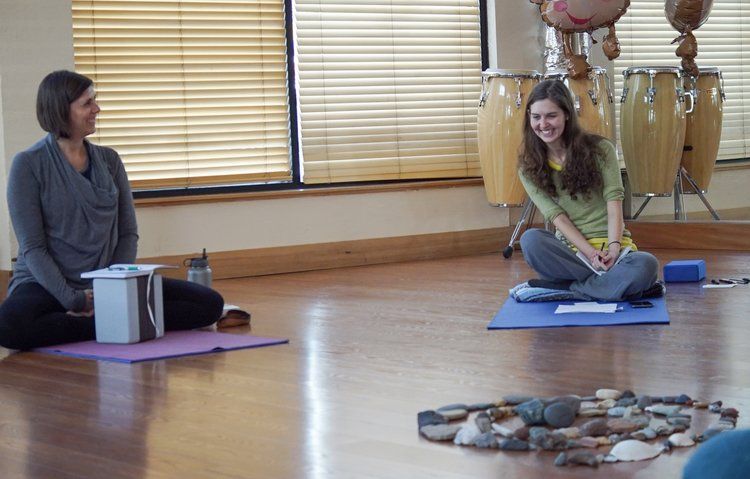
On the other side of the country, my soon-to-be-friend Alyssa Englund was having a life-altering experience of her own. Once a high-powered lawyer in New York, cancer forced Alyssa to take a step back, slow down, re-examine her path, and ultimately find a new one altogether. That journey led her to become a yoga teacher in Portland, Oregon, where we eventually crossed paths. Together, we spoke about our experience as survivors. And while it’s not possible to boil the sum total of all cancer narratives down into any essential universal truth, we found a lot of common ground that warranted further attention.
Many late night talks and countless cups of chai later, we formed Bridge Prose, a writing/yoga workshop designed to address several important points:
1. The experience of young adults with cancer is not accurately depicted in existing media.
Movies, TV, well-intentioned PSAs, hospital advertisements, information pamphlets and even some other charity organizations providing services for those with cancer often tell a story that doesn’t come from survivors themselves. Survivors can and should be invited to speak for themselves. We have something to say.
2. Not everyone is compelled by “battle” imagery.
For some of us, the idea of the “you’re so strong” Cancer Warrior who is “fighting cancer” or “beating cancer” or “kicking cancer’s ass” creates an expectation of stamina that many of us struggle to embody. My own experience with cancer didn’t feel like a battle, so much as a slow walk with a lot of breaks to sit down. And while yoga does give us the opportunity to strike the occasional Warrior Pose, we also acknowledge that we can’t be kicking ass 24/7. Nor should we! Stillness, relaxation and reflection are important parts of any healing process.
3. Telling your story has power.
Psychologist James Pennebaker studied the impact of people being able to tell their stories. And while this study isn’t specifically about cancer, its findings are meaningful: People who talked or wrote about their traumatic experiences were found to be of better health, went to the doctor less, and had noticeably lower stress hormone levels. He concluded, “The act of not discussing or confiding the event with another may be more damaging than having experienced the event.” To me, this is huge. Cancer can be an isolating and even shameful experience for people who don’t have a space where they feel they can speak openly about their experiences.
4. Your body is part of your story.
Though we don’t get to choose what we look like or what limitations our bodies come with, these details are a big part of who we are and how we move about the world. For most people, yoga practice isn’t about being able to do upside-down splits in the air while balancing on someone else’s hands. Instead, once we let go of judging ourselves for what we can or cannot do, yoga becomes a practice of honoring the silent conversation we have with our bodies. My body and I have decided I’m never going to be able to touch my toes, and that’s just fine. Turns out it’s not a necessary life skill! Accepting my limitations helps me appreciate my strengths.
5. A trusted community is essential. So is a cup of tea.
Exploring your personal traumas and physical limitations in a group setting can definitely be hard, and yet that community aspect is so important. We like to set the stage for a warm-hearted discussion with a nice big cup of tea. Drinking tea has been a beloved cross-cultural human ritual for centuries, and there are plenty of reasons why. Several studies have connected regular tea consumption with higher cognitive function, improved memory and lower risk for depression. Not to mention the famous University of Colorado study that found people perceived one another more positively while holding a warm beverage. Overall, the ritual of drinking tea brings people together and (at its ideal temperature) reminds us that some of the best things in life can only be appreciated slowly and deliberately.
For a year now, I’ve been leading a weekly writing workshop for cancer survivors at a hospital in my area, and Alyssa has been teaching a weekly yoga class with a focus on the First Descents community. In September, we finally held our first Bridge Prose workshop, combining the benefits of meditation, yoga, writing our stories, and enjoying one another’s company over tea. We found connection and community with a wide range of people from different backgrounds.

Sitting in a circle on the floor with a pot of yerba mate between us, two participants expressed they had both been longing for an opportunity to connect with other survivors in a way that felt accessible to them. Both laughed about how intimidated they were to sign up for a recent overnight hike with other survivors, citing concerns about how they’d manage to keep up. It’s great that more physically intensive opportunities are out there (Alyssa had also organized that hike!), but many of us still find ourselves looking for the perfect avenue to make a connection that fits our own lifestyle.
For many, cancer survivorship is not a process of reclaiming the person we once were, but finding ourselves in the new person cancer forces us to become. “That process can be a long one,” said one participant, “and is best experienced with friends.”
– Brianna Barratt